
A few thoughts on Australia’s ‘international student problem’
Do I agree with Pauline Hanson? To a point. As a master’s student, here’s my take on the international student situation.


It is an unfortunate truth that hateful, misguided, self-serving politicians do have a knack for weighing in on real social problems. But their solutions are so simplistic as to miss the true cause of the problem altogether.
Recently, Pauline Hanson spoke about the reality of university life in Australia, noting that classes are dominated by international students (true) who can’t speak English (in my experience, only partially true) and make group assignments a struggle for domestic students (again, in my experience, only partly true).
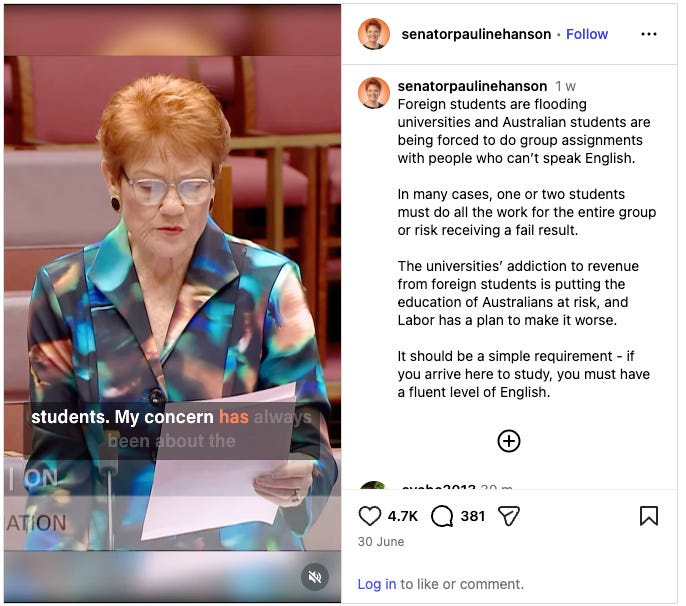
But the fact is that everyone I speak to about university — students, parents, recent graduates — is saying the same thing. Universities are overwhelmed with international students. The cultural and linguistic divide on campus is real. There is a sense that the university system is focused solely on foreign student revenue, with little regard for the experience these students and their domestic counterparts receive while at university.
This is not about being xenophobic or anti-immigration — not, at least, for the majority of people I talk to (can’t say the same for Hanson). It’s just about having a university experience commensurate with the price paid. And the disproportionate volume of students who do not have the requisite grasp on English, as well as those with no plans to stay in the country, have fundamentally changed the university experience for domestic students (and, importantly, also for international students).
The Australian university system is broken, and everybody knows it. Yet if Pauline Hanson is the only person talking about the dismal state of the university system (even if only through a narrow lens), she gains ground once more. And as is always the case with Hanson’s supposedly common-sense stance on social issues, there’s a lot more going on here. The international student problem is a symptom, not a cause. The challenges facing students, teachers, and universities at large are real and have been building for decades, yet few mainstream politicians are tackling them in a serious manner.
What it’s like to attend a degree program on-campus in 2026
I love and seek to protect Australia’s cultural diversity. I myself was an immigrant to Canada, and my partner is an immigrant here. But the unavoidable fact — one I have been forced to confront as a current master’s student at the University of Queensland — is that the overwhelming presence of international students on campus has drastically changed what it means to be a university student (domestic or international) in Australia. Ironically, such high levels of international students, particularly when language requirements are so low (more on that later), lead to a kind of individual cultural homogeneity on campus, with students sticking pretty tightly to their own cultural groups. Again, I love cultural diversity, but that’s not quite what’s happening here. Each group retains its cultural and linguistic homogeneity (much like Pauline’s notorious monoculture), resulting in a particularly shallow kind of cultural diversity.
As of 2024, international students reportedly made up almost 33% of student cohorts, on average. Numbers can be far lower or higher depending on the university and the program. In my master’s degree program at the University of Queensland, the vast majority of students attending in-person courses are international. Anecdotally — and this is based only on my in-class experience — international students make up at least 80%, if not more, of the student body. Having taken courses both on-campus and online, I have noticed far more domestic students in the online courses, which they can take in the evenings, as most of them work full-time. There are very few full-time domestic master’s students heading to campus, likely because the economic conditions for most working Australians make it all but impossible to pause work in order to pursue study full-time — especially in a world where the ROI on many university degrees is diminishing rapidly.
Unfortunately for domestic students, higher percentages of temporary international students on campus necessarily change the way university friendships are formed and networks are built. Friendships and professional networks are among some of the most valuable rewards of a university education. When only a small portion of your cohort speaks adequate English and plans to stay in the country, this changes both the experience of completing your degree and the returns it yields throughout your career.
Although Hanson’s points are not quite as nuanced as this, the students who have experienced the new university life, and perhaps even their parents, may well be feeling that Hanson is the only politician who understands or cares about on this topic. That’s a shame, because Hanson doesn’t care (if she did, she’d stop blaming international students for what is ultimately a government failure). But let’s turn to language requirements, as they seem to be a real sticking point for Hanson.
What’s in a language?
In declaring that international students must meet language requirements to enrol in a program, Hanson implies that there are no existing language requirements for international students. This is not true. Australian universities do have minimum English language requirements.
At the University of Queensland, where I am currently pursuing my degree, international students must score a minimum of 6.5 on the standardised IELTS English language test, unless they meet other conditions.
So Pauline Hanson is technically wrong when she implies that universities do not already have minimum English language standards, but in reality, she is right. There are a number of problems with current language standards: firstly, the universities simply drop them when enrolments are lagging. Secondly, there are several ways to bypass these requirements (and students tell me this happens frequently). Thirdly, and I have seen few people talk about this, is the reality that a score on an IELTS test may not translate (pun intended) to life in an Australian university classroom, where teachers talk quickly and frequently throw around slang and subject-matter-specific vocabulary. Some kind of standard language testing is evidently necessary, but there will always be a disconnect between the sterility of the testing environments and real life. If we really want students to be able to engage with teachers and fellow students, supplementary English support seems necessary.
I have sat next to students in class who quite clearly had no idea what the teacher was saying. These students were using translation apps and even ChatGPT to record the teacher and translate in real time, but evidently, this is not an ideal way to follow a lecture. I have seen them unable to log in to student portals because they could not read log-in instructions, generate fully AI-written assignments with no comprehension of what they were handing in, and present to the class from AI-created notes and slides in spoken English that is so poor as to be incomprehensible. I say this not from a place of criticism but a place of concern. Surely, this is no way to get an education.
Not all international students struggle in this way. But there is something happening with a sizeable cohort of students who clearly do not have the requisite grasp of English to be here. From what I’ve seen, I cannot believe that many of these students would meet a 6.5 IELTS requirement, and I refuse to trust the universities on this matter. After all, what incentive do they have to filter for English proficiency? If the goal is to maximise profits rather than the experience of students and teachers, then it stands to reason that the universities will optimise for international student revenue at the expense of educational outcomes and the university experience.
The steady erosion of Australia’s education system
Hanson says that the influx of foreign students is putting the education of Australians at risk. This argument has about as much validity to it as the claim that international students are responsible for the housing crisis. The education of Australians, from primary to tertiary, has been at risk and in decline for decades.
“Degrees are being devalued,” says Hanson, “and teaching standards are in decline.” Both of these are true statements, and yet the assumption is that it is international students driving these trends and not, as is more accurate, that the prevalence of international students is one symptom among many of a much deeper cause.
Hanson claims Australian universities are “addicted to foreign student money,” without questioning the root of this addiction. In reality, Australian universities first turned to international students as a survival mechanism after losing much of the government funding that had previously sustained them. International students were, for a time, the universities’ only hope.
Beyond a loss of government funding for universities, we’re also seeing increasing inequality between public and private schools, an obvious misuse of government funding for private schools (hello, school principal salaries and brand-new Olympic swimming pools), and literacy rates dropping (a third of Australian kids can’t read proficiently). By the time students get to university (if they make it), the cost of living in major Australian cities is so high that even Commonwealth-supported placements and HECS loans make studying in major cities all but impossible for many potential students. The pressures faced by teachers and the precarity of academic work in Australia mean teachers are stretched beyond belief. And now we have AI threatening the entire system. The list of issues plaguing Australia’s university system is long and depressing; I highly recommend Graeme Turner’s short book Broken for more on this subject.
We don’t hear Hanson speak to any of this, and it would be hard to imagine her voting in support of increasing government funding for universities — that is, reversing the problem that led to the reliance on international student revenue in the first place. “My concern has always been about the welfare of Australian students,” says Hanson. But if that were the case, why not address bigger issues in the education system? It is disappointing, but not surprising, that the only thing that gets Pauline Hanson interested in the state of the Australian education system is when people who are not Australian appear to be taking advantage of it, rather than what they are really doing, which is propping up what little is left of it. Against this backdrop, Hanson’s vague demand for language requirements would be akin to sticking a Band-Aid on a severed limb.
Take the group assignments Hanson is so worried about. This is a problem that exists independently of international students. Every student I know hates group assignments, and every person I know, former student or not, thinks having your academic standing hinge on the work of other students is downright unfair. There is no reason one student should be judged on the quality of another’s work, language implications aside. But the popularity of group assignments in Australian universities appears to have reached an all-time high, and it all comes down to resource scarcity. I’m not blaming teachers here, given the pressures they also face. Group assignments, in this scenario, may simply be a survival mechanism.
But if this is the case, then we need far greater reforms, because everyone is suffering here, except perhaps the Vice Chancellors and the consulting firms. The need for change is evident to anyone with eyes and ears. Unfortunately, the attention of people like Pauline Hanson can only be seized when the words international students are floated.
A university system dependent on private income simply cannot do what is best for its students — domestic or international. The relentless pursuit of profit creates a kind of tunnel vision that almost always results in the enshittification of the service provided.
Whether the consequence of survival instinct or, potentially, greed, the appetite for international students is a late-stage symptom of a university system that has been in trouble for a long time. Yet the university system cannot be repaired with the same system that broke it, but that is exactly what Hanson would have us believe.
An anti-establismhment politician such as Hanson, cosy with billionaires and hard-right extremists, represents an even more extreme version of the kind of neoliberal political leadership and penchant for privatisation that caused our current university crisis. It cannot also be the solution.
Australia’s reputation for educational underachievement
Australia’s culture of underachievement in education runs deeper than university financial pressures. The dominant attitude in Australia is that university is a tool for vocational training rather than an asset for the public good, a place for building civic engagement, or a setting for facilitating personal discovery. “Just get your piece of paper and then you can start working,” my parents would tell me, and broader experience tells me this is the dominant Australian attitude towards tertiary education. As the university experience becomes increasingly enshittified, Australian students have an even stronger reason to focus on the resulting piece of paper and get out as soon as they can. (Again, more on this in Graeme Turner’s excellent book.)
Perhaps the wake-up call we need comes directly from the international students themselves. One of my good friends in Melbourne, who came here as an international student from China and has since stayed, told me that Chinese students apply to Australian universities because it’s considered the easy way out. The language requirements are minimal, and the educational standards are so far below those of Chinese institutions and many others around the world that the students looking to satisfy their parents’ desires for a degree without putting in undue effort have set their eyes on Australia.
As an enthusiastic student who was deeply disappointed with my mainstream school and university experience, this was both unsurprising and deeply embarrassing to hear. The international student community looks to Australia as the easy way out. Perhaps, if our educational standards (not just our language standards) were more rigorous, Australia would no longer be the escape path it is reputed to be.
What is the role of the university in Australian life?
The value of a university degree has been declining for decades. In this regard, the universities were victims of their own success: the more students they educated, the less ‘valuable’ an education became. Yet now, with AI infiltrating every sphere of knowledge work and the universities themselves, universities are under more pressure than ever to claim relevance. Some will say that AI renders universities obsolete; I see it in the opposite light. University degrees were already unnecessary or unhelpful for many professions. Now, we can turn the focus away from university as vocational training. More than ever, we should be able to offer students the joyful and important experience of learning how to think; of developing an appreciation for the world that came before them and starting to think about how they might improve the world they inherited.
AI is no reason not to focus on improving the educational standards and experiences for students in primary school, high school and universities. An educated nation has a far better chance of helping itself; of working its way out of some of the many challenges facing countries today.
If educational standards were higher in this country, perhaps we could finally break free of the Stockholm syndrome that characterises our present-day relationship with the US. Perhaps we would find a way to generate wealth without exporting fossil fuels. Perhaps we would work out how to use technology for the betterment and not the detriment of our society.
On my first glance at Hanson’s take on international students, I worried that I might agree with her. On the surface level, I do. I do agree that the university experience can be a difficult one when the vast majority of your classmates are international students who have no long-term plans to stay in Australia. I do agree that language entrance requirements are clearly too low or too easy to bypass, making teaching and learning difficult for all involved.
But that’s where Hanson and I part ways. I do not believe that international students are to blame, or that they represent the only or most pressing problem in the Australian educational system. And I do not — not for a second — believe that Pauline Hanson’s policies are the answer.