
Pauline Hanson and the Illusion of Common Sense
Australians yearn for a return to ‘common sense’. Hanson’s simple solutions to complex problems are not the answer.

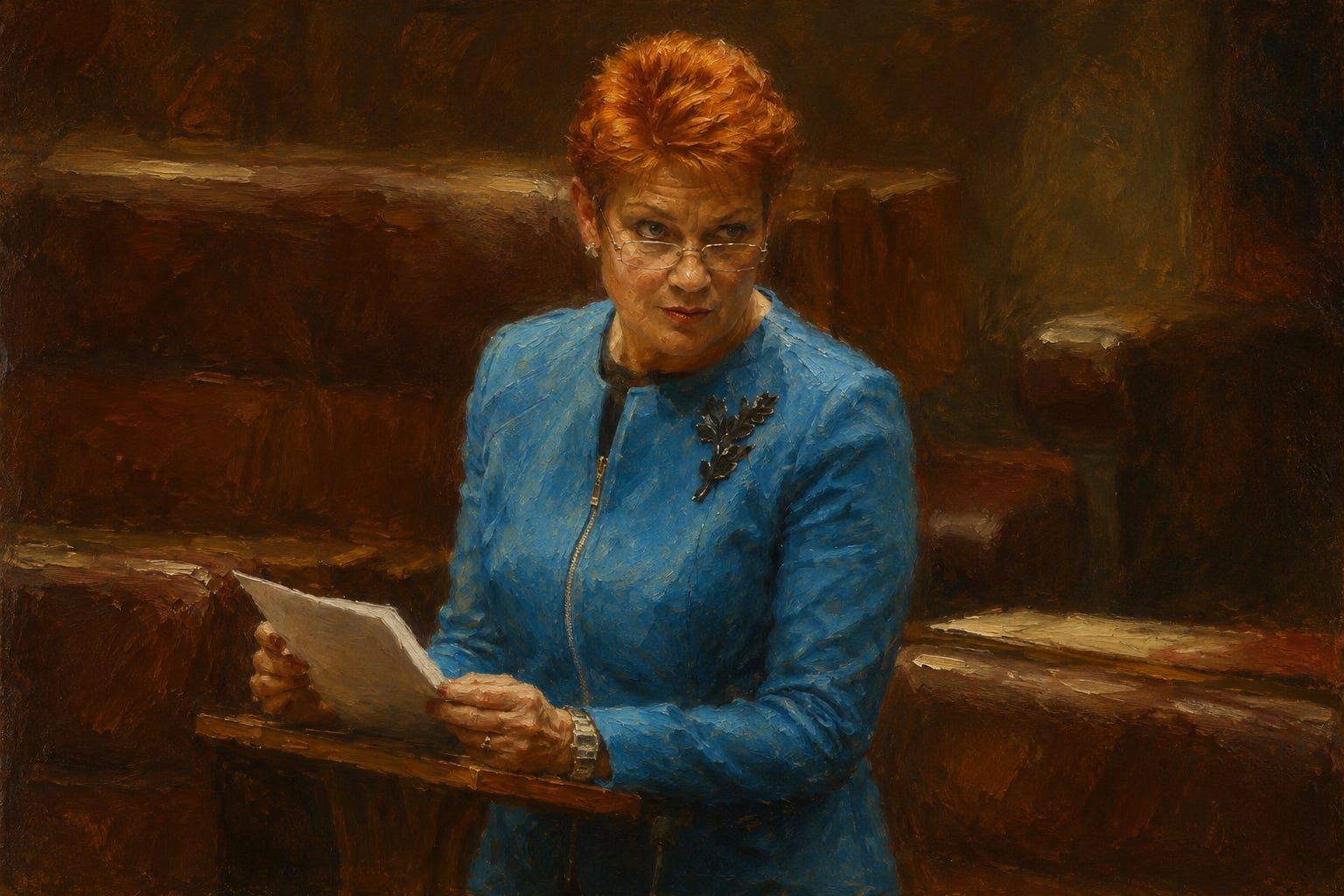
Last week, in a scene that looked more like something we might imagine taking place in a faraway time or place, Pauline Hanson took to the stage at the National Press Club to outline her vision for the future of Australia.
As she sat politely to the side of the stage, the host listed the ‘accomplishments’ amassed over Hanson’s 30-year political career, including her jail time and electoral fraud charges and her “many failed attempts” to re-enter parliament over the years.
Safe to say things are already off to a weird start when Hanson takes the microphone.
“Well first of all I’ve got to welcome my team,” she begins, “my colleagues, my cohorts, whatever,” she says. Declining to preface her speech with a “divisive” Welcome to Country, Hanson prefers instead to launch into an immediate attack on her fellow politicians, immigrants, and transgender minorities.
Though her speech is always hateful and full of grievance, it is frequently confused. “And no,” she says, as she tells Channel 9 that Gina’s jet is not broken, “I didn’t come cattle class. Or I did come cattle class, actually.” Please explain?
After three decades in the public eye, Hanson has developed no more eloquence, no more charisma, no more agility of reply. Her voice is wavering and often uncertain despite the finality of the words she reads from the page. To hear hate delivered in such an unconvincing and uncharismatic tone is to be continually baffled by this woman’s appeal.
A lack of eloquence might be easier to overlook if the logic underpinning Hanson’s core arguments and policy proposals was sound. Yet just as Hanson often confuses her words, so too does she confuse scapegoats for solutions.
As best I can surmise it (for it is entirely lost on me), Pauline Hanson’s appeal is wrapped up in her supposed embodiment of common sense. Yet what may appear to be good old-fashioned common sense is, in a policy context, an extreme oversimplification of Australia’s complex problems and the vilification of an easy target. The appeal of this approach can’t be overstated: in Hanson, the average voter gets a simple, straightforward answer to problems that seem enormous and confusing, and it comes in the form of a scapegoat to blame. (In this speech, we got three: immigrants, transgender people, and lazy young workers who are always on their phones but can’t be fired.)
Supporters will claim that Hanson “says it like it is” — she doesn’t, of course, because to actually say it like it is when talking about Australia’s complex problems would take a long time and, one might wager, a more sophisticated circuitry of mind than that which Hanson possesses. But the sense that Hanson is saying it like it is offers magnetising appeal for the basic Australian instinct that common sense is the solution to all problems.
Last week, seated on the Australia Zoo shuttle bus and inching through the pristine bushes at a glacial pace, my grandmother and aunt struck up a conversation with some travelling Tasmanians behind us, which quickly turned to politics. The country is going to hell in a hand basket because of the politicians, the man behind me said. “They’re overeducated, but they’ve lost their common sense,” he continued. All were in agreement: less education, more common sense, and the country would be in a far better place.
Perhaps it looks that way, from the shuttle bus, but the reality is that our world is now so complex, our problems so layered and multifaceted, stakeholders so numerous, that resorting to common sense (let alone determining whose common sense we would resort to) cannot suffice.
In their desire for simplicity — in their desperation to make sense of what feels like an increasingly confusing world — Australians are reaching for whatever sounds simplest. The cognitive fallacy at play here is that simplicity equates to truth; that short sound bites and problems with singular causes represent good old-fashioned common sense, and not, as they actually do, dangerous oversimplification.
If things should indeed be made as simple as possible, but no simpler, Pauline whizzes straight past the former and into the latter, sans reservation.
Simplicity is wonderful and necessary, but oversimplification is a curse; one that sends us in the wrong direction. Take Hanson’s explanation for the housing crisis, which is, predictably, immigrants. Never mind the complex interplay between tax policy, cultural attitudes towards wealth-building, supply shortages, and so on. Hanson is not here to acknowledge complexity, only to simplify problems in a way that reveals a single scapegoat.
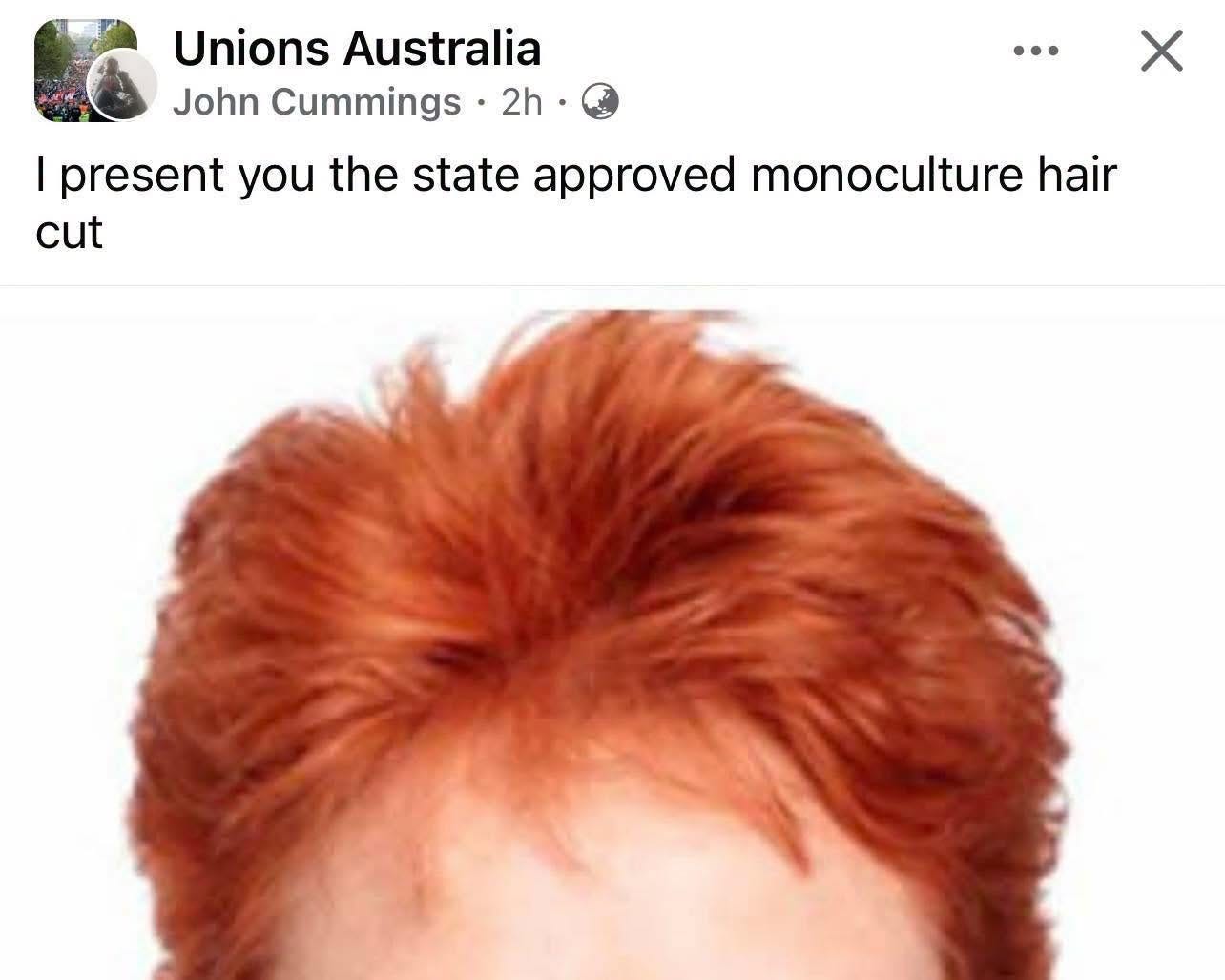
Hanson’s viral, dystopian vision of an Australian monoculture is another laughable simplification. Putting aside the fact that she seems to have much trouble defining it or locating its mythical existence in our country’s history, Hanson is betting on the idea that denuding us of our cultural and linguistic diversity will solve our growing social polarisation.
In claiming that a monoculture would repair social divides, Hanson oversimplifies by conflating cultural identity with values and behaviours, while also imagining that the only differences people can have arise from the colour of their skin or the language they speak in their living rooms.
Hanson is obsessed with racial, linguistic, and cultural differences while completely ignoring the biggest cultural divide of all: wealth inequality (which also appears as intergenerational inequality). At this point, unable to buy a house in the city where I live and working three jobs between us, my partner and I have far more in common with our ‘immigrant’ neighbours than I do with my own grandparents; perhaps even my parents. Throw in the corrosive influence of short-form, algorithmic media, digital addiction, and a the gradual decaying of third spaces and civic engagement, and the picture of Australian social divides becomes a lot more complex. But Hanson’s solution to our division is an end to “divisive” Welcomes to country (as if a message of welcome is somehow offensive) and a boiled-rice vision of cultural homogeneity, rather than a diverse and accepting culture buoyed by strong government safety nets, abundant third spaces, well-funded public schools, reliable public infrastructure, and economic peace of mind.
Pauline Hanson does not want to acknowledge the complexity of the problems facing Australia. Complexity evades capture in simple slogans, doesn’t go viral in the way a word like monoculture does, and can’t be understood without the kind of sustained attentional capacity that is rapidly being drained from the population. In oversimplifying reality, Hanson would appear to be promising bold action over incremental change — and boy, are Aussies sick of incremental change. But we should be wary of our tendency to mistake bluster, outspokenness, and even outrage for political courage. Pauline Hanson’s ‘solutions’ will only make our problems worse, but in order to understand that, we must be comfortable with complexity; must resist the pull towards undemanding answers.
Aussies are desperate for simple answers to big problems. What they really want, if you ask most of them, is a simple life. In proposing simple solutions to complicated problems, Hanson offers the illusion of simplicity and common sense, but her policies all but guarantee to make life more difficult, more complicated, and more problematic for Aussies.
As our country drifts to the far right, here’s a book I highly recommend Australians read:
My Favourite Book of 2025: On Freedom, by Timothy Snyder

“If a book about freedom doesn’t mention childbirth, you don’t have to read it.” — Timothy Snyder